Authoritative DNS Versus Cloud DNS Explained
Authoritative DNS versus cloud DNS is not a direct feature contest. Learn what each term means, where they overlap, and how to plan safe zone operations.
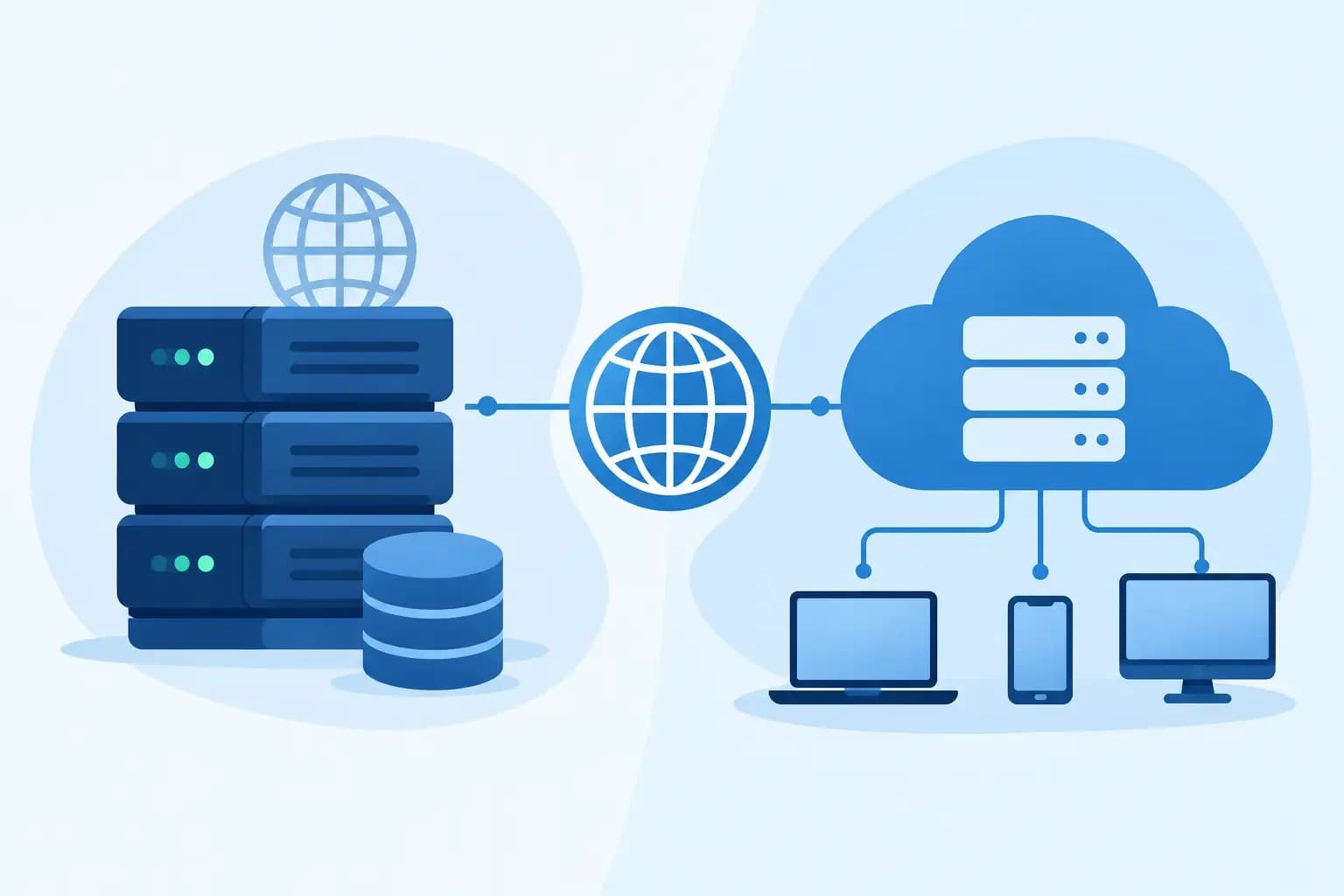
Authoritative DNS versus cloud DNS is not a direct feature contest. Learn what each term means, where they overlap, and how to plan safe zone operations.
A customer reports that their website is unreachable, but mail is still flowing. The incident may be in a hosting account, an application, a proxy, or DNS. Before changing nameservers or rebuilding a zone, the team needs to identify which system is actually answering for the domain.
That is why authoritative DNS versus cloud DNS is often framed incorrectly. These terms do not describe two mutually exclusive technologies. Authoritative DNS describes a DNS role. Cloud DNS usually describes a delivery and management model. A cloud DNS service can be authoritative, and many are. The operational question is not which label wins. It is which architecture gives your team the required control, visibility, change safety, and recovery path.
Authoritative DNS Versus Cloud DNS: Separate the Terms
Authoritative DNS servers hold the DNS records that define a zone. When a resolver asks for the A record for `www.example.com`, the authoritative server provides the answer published for that zone. It does not recursively search the internet for an answer or return a cached response from another DNS source.
A zone's delegation determines where those authoritative answers come from. The registrar publishes NS records for the domain, directing resolvers toward the designated nameservers. Those nameservers may be operated on infrastructure your team manages, provided by a specialist DNS company, or delivered through a public cloud platform.
Cloud DNS generally means DNS delivered as a managed cloud service. The provider operates the DNS fleet, network footprint, availability systems, and API-driven control plane. Your team manages zones, records, access permissions, and integrations rather than maintaining authoritative DNS daemon processes, server patching, replication topology, and nameserver capacity.
The important distinction is simple: authoritative DNS is the function. Cloud DNS is one way to operate that function. A self-managed PowerDNS or BIND deployment can be authoritative DNS. A managed DNS platform with globally distributed nameservers can also be authoritative DNS.
Confusing the two can lead to poor technical decisions. A team may believe that moving to cloud DNS removes the need to manage DNS risk. It does not. It changes the risk profile from nameserver operations toward identity controls, API permissions, zone lifecycle management, provider dependencies, and safe change practices.
What Self-Managed Authoritative DNS Controls
Operating your own authoritative DNS infrastructure gives you direct control over software, server placement, zone storage, transfer policies, query logging, and integration design. For hosting providers with established automation, that control can be useful. DNS provisioning can be tied closely to customer account creation, reseller boundaries, internal IP allocation, and custom service discovery.
It can also support requirements that managed services do not fit cleanly, such as private network placement, a specific database backend, custom record-generation logic, or strict control over zone transfer behavior. Teams with deep DNS expertise may prefer to own the full operating model.
That control has a cost. Your team is responsible for authoritative server availability, geographic redundancy, software updates, capacity planning, denial-of-service resilience, DNSSEC key handling, monitoring, and secure replication. A configuration error in a hidden primary, a failed transfer to a secondary, or an expired DNSSEC signature can affect every customer zone relying on that system.
Self-managed authoritative DNS is not inherently less reliable than cloud DNS. Well-designed deployments can be highly dependable. But reliability depends on the operating discipline behind them: independent failure domains, tested failover, monitored zone propagation, controlled access, and documented recovery procedures. Small teams frequently underestimate how much operational work is embedded in the phrase “run your own DNS.”
What Cloud DNS Changes
Cloud DNS shifts much of the authoritative serving layer to a provider. The provider manages nameserver infrastructure and commonly supplies distributed anycast routing, capacity at scale, service monitoring, and an API for zone administration. This can remove a significant amount of server-level work.
For an infrastructure team, the practical benefit is often not merely global DNS capacity. It is the ability to apply DNS changes through a defined control plane. Records can be created by automation, reviewed through audit records, limited through role-aware access, and associated with a specific customer or environment.
Cloud DNS also introduces a provider boundary. The service's record model, API behavior, DNSSEC workflow, export options, limits, and access-control model become part of your architecture. Some platforms support all common record types but may impose constraints around zone transfers, custom nameservers, advanced routing, record counts, or delegation patterns. A provider's service incident, account lockout, credential failure, or regional control-plane disruption may affect your ability to make changes even if existing DNS answers continue to resolve.
The serving plane and the management plane should be evaluated separately. A cloud provider may continue answering DNS queries globally while its portal or API is unavailable. That distinction matters during an incident. If a customer needs an emergency MX correction or a failed certificate validation requires a new TXT record, your team needs a tested path to make that scoped change under pressure.
The Operational Decision Is Usually Hybrid
Many hosting providers already operate a hybrid model, whether they call it that or not. They may use managed authoritative DNS for public customer zones, private DNS for internal service discovery, and registrar DNS only for a small set of parked domains. Others use a self-managed authoritative cluster as the system of record and publish secondary service through an external provider.
The right design depends on the workload. Public zones for a large customer base benefit from distributed authoritative capacity and strong separation between customers. Internal zones may need private visibility, custom integrations, or network-local resolution that public cloud DNS is not intended to provide.
The decision should also account for support workflows. A DNS platform is part of the incident-response path when a domain fails validation, a customer changes mail providers, a site moves servers, or a compromised account requires a DNS rollback. If support staff can edit any zone without context, the architecture is fast but unsafe. If every correction requires broad administrative access and manual coordination, the architecture is controlled but slow.
A better model provides scoped authority. An operator should be able to identify the affected zone, inspect the current records, preserve related mail records, make the required change, and retain a clear execution record. For a nameserver migration, that means comparing the source and destination zones before delegation changes, not assuming that an exported zone is complete.
DNS Changes Need Recovery, Not Just Automation
The most damaging DNS failures are often ordinary changes made without complete context. Replacing a zone to point a website at a new host can remove MX, SPF, DKIM, DMARC, verification, or autodiscovery records. Lowering TTL ahead of a migration can help, but it does not fix an incomplete target zone or incorrect delegation.
Before changing an authoritative DNS provider or modifying a production zone, establish the intended record set and a recoverable baseline. Capture records, TTLs, nameserver assignments, DNSSEC status, and any provider-specific routing behavior. Confirm who can approve changes and which credentials or API keys can execute them.
For a nameserver move, validate the destination zone before updating registrar delegation. Confirm that the new authoritative servers return the expected answers directly, including mail and certificate-validation records. If DNSSEC is enabled, coordinate DS record changes and signing status carefully. A working unsigned zone can become unavailable if a stale DS record remains at the parent.
After the change, monitor the authoritative response rather than relying only on a browser test. Browsers, recursive resolvers, and local operating systems cache results differently. Check the published NS set, expected answers from each authoritative nameserver, SOA serial behavior where applicable, and the records needed by dependent services.
Recovery should be bounded. Reverting an entire zone may restore one record while overwriting legitimate changes made during the incident. When possible, restore only the affected records or return to a known zone version after reviewing the delta. This is where DNS-safe changes and usable audit history matter more than broad automation claims.
Questions That Produce a Better Choice
Start with ownership. Does your team need control of the DNS software and network layer, or control of zones and policy only? Then examine failure handling. Can you access and modify zones if the primary management interface is unavailable? Can zones be exported, reconstructed, or served from a secondary provider when necessary?
Next, assess delegation and permissions. Hosting operations often need to create records as part of provisioning, while support teams may need limited authority to correct a customer record. Those are different permissions. The platform should avoid turning routine support work into unrestricted access to every production zone.
Finally, test the real workflows. Provision a customer domain, preserve mail records during a hosting migration, rotate an API key, roll back an accidental TXT deletion, and investigate who changed an A record. If the design cannot support those tasks with visible context and defensible records, its architecture is incomplete regardless of where the nameservers run.
Cloud DNS can reduce the burden of operating authoritative infrastructure. Self-managed authoritative DNS can provide deep control where that control is justified. The stronger choice is the one that lets your team make scoped changes, verify the result, and recover without guessing when production pressure is highest.