Server Change Approvals That Protect Production
Server change approvals reduce production risk with clear scope, accountable owners, rollback plans, and auditable execution records for every action.
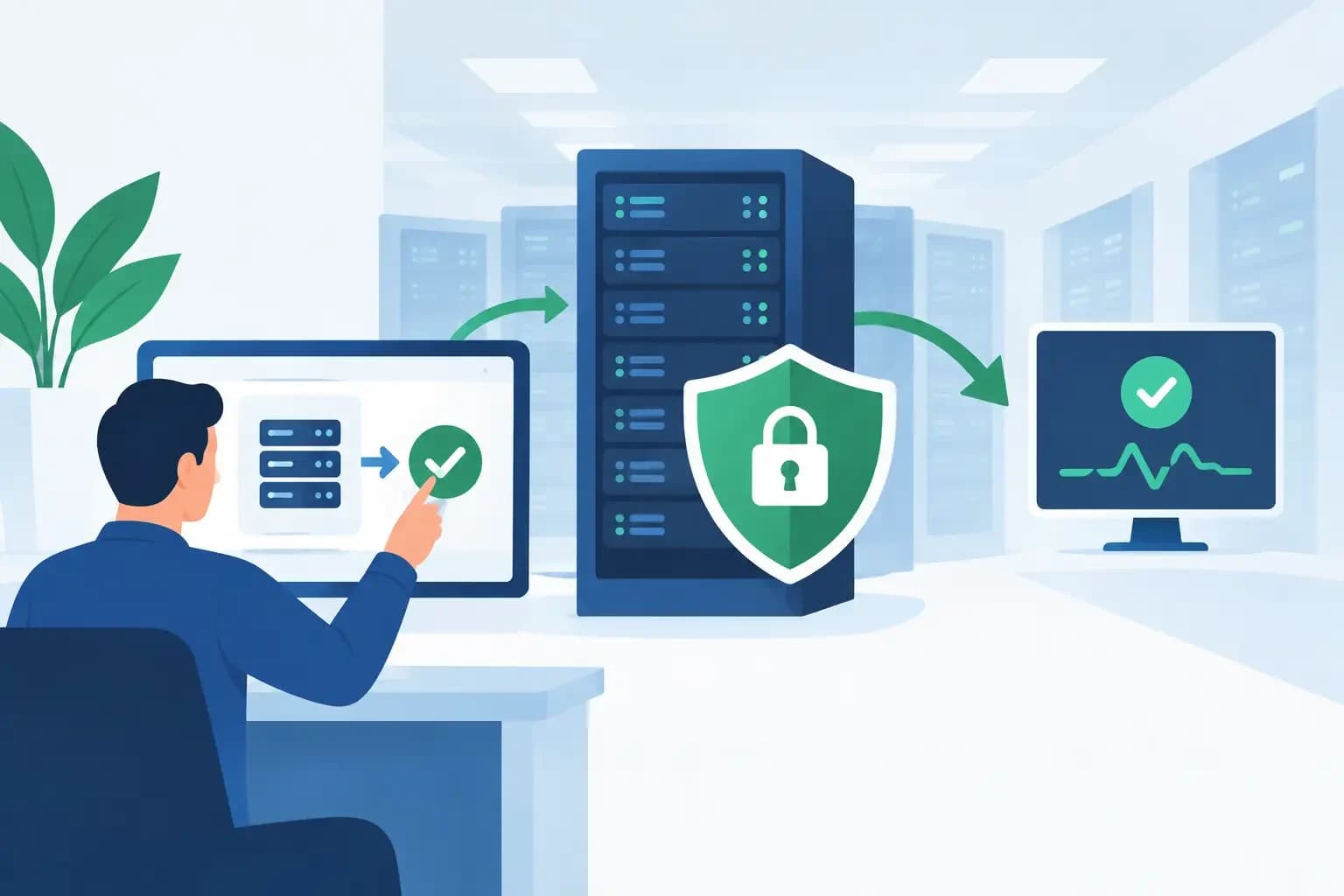
Server change approvals reduce production risk with clear scope, accountable owners, rollback plans, and auditable execution records for every action.
A production server change can look small in a ticket and still affect hundreds of customer environments. A package update may restart a service. A firewall adjustment may block backup traffic. A nameserver migration can preserve a website while breaking MX, SPF, or DKIM records for mail. Effective server change approvals exist to expose those dependencies before execution, not to add ceremony after the risk is already understood.
For hosting providers and infrastructure teams, the goal is not to force every change through a slow committee. It is to apply the right level of review to the right level of operational impact. A controlled approval process gives operators room to act quickly while preserving ownership, context, recovery options, and a defensible record of what happened.
Why server change approvals fail in practice
Most approval failures are not caused by a missing approver. They happen because the approval request does not contain enough operational detail for someone to make a sound decision. “Update the server” is not a change plan. Neither is “fix DNS” or “increase storage.”
An approver needs to see the affected systems, the exact intended action, the expected service behavior, and the recovery path. Without that information, approval becomes a rubber stamp. The team may satisfy a process requirement while still operating without meaningful control.
The opposite failure is equally costly. When routine, reversible work requires several manual approvals, operators route around the process during an incident or delay needed maintenance until risk accumulates. The answer is not to remove approvals. It is to distinguish low-risk, repeatable work from changes that can alter customer availability, data integrity, security posture, or recovery capability.
A planned rotation of a documented API key with tested dependencies is different from changing the server’s primary network configuration. Restoring a single customer database to an isolated destination is different from restoring an entire server in place. The approval standard should reflect that difference.
Build approvals around operational impact
A useful approval decision starts with scope. The requester should identify not only the server, but also the services, accounts, zones, storage targets, and integrations that could be affected. In a hosting environment, one shared server may contain web applications, mailboxes, databases, scheduled jobs, SSL renewals, backup agents, and customer-specific DNS dependencies.
The request should then make four facts explicit: what will change, why it is necessary, what could be affected, and how the team will recover if the result differs from expectation. These are not documentation exercises. They establish whether the proposed action is bounded and whether the operator can detect failure before it becomes a wider incident.
For example, consider a request to replace a server IP address. A complete approval record should address hosted account bindings, outbound mail reputation, firewall rules, monitoring targets, backup destinations, license activation, reverse DNS, certificates, and any DNS records that reference the address. If customer domains use external DNS, the plan also needs to identify who owns those records and how propagation will be monitored.
That level of context allows an approver to ask useful questions. Is the new address already present in the relevant allowlists? Is reverse DNS configured before mail routing changes? Is there a rollback window before the old address is released? Are customer-facing DNS updates scheduled with sufficient TTL awareness? The approval process becomes a technical checkpoint rather than an administrative delay.
Define change classes before the incident
Teams should not be deciding approval requirements from scratch when a service is degraded. Establishing change classes in advance creates consistency and reduces argument during high-pressure work.
A standard change is repeatable, documented, and known to have a limited impact when performed under defined conditions. Examples may include a scheduled operating system patch with a tested maintenance procedure, adding capacity to an established backup repository, or rotating credentials through a documented sequence. Standard does not mean unreviewed forever. It means the procedure, permissions, validation checks, and rollback conditions have already been approved.
A normal change requires review because its impact varies by environment or timing. Migrating a customer group to new storage, altering database settings, modifying mail routing, or changing shared server limits usually belongs here. The plan should receive technical approval before the maintenance window, with a clear owner responsible for post-change validation.
An emergency change addresses an immediate threat to availability, data, or security. It may need to proceed before the usual approval path is complete. That does not eliminate control. Emergency execution should be narrowly scoped, recorded as it happens where possible, and reviewed afterward. The record should explain the triggering condition, the authority used, the actions taken, and whether follow-up remediation is required.
What every approval request should contain
The most effective requests are concise but specific enough to support an informed decision. They should include the target systems and customer scope, the implementation sequence, a maintenance window when relevant, named operators and approvers, validation criteria, and a rollback plan.
The rollback plan deserves particular attention. “Restore from backup if needed” is not sufficient when a change could affect a shared production environment. Specify the recovery point, restoration scope, estimated recovery time, dependencies, and decision point for reversing the change. Can the team restore only the affected database? Can it roll back a configuration version without overwriting newer customer data? Is a scoped restore point available before the work begins?
Validation should be equally concrete. After a DNS-related server change, validation might include authoritative resolution, preservation of MX records, successful SPF and DKIM lookups, mail flow testing, and confirmation that existing web records still resolve correctly. After a storage change, it might include backup job completion, restore testing, disk latency, capacity monitoring, and confirmation that retention policies still apply.
These details create an execution record that is useful later. If a support engineer receives a customer report after the maintenance window, they can see what changed, who approved it, what was validated, and which recovery options remain available.
Keep approval authority close to the risk
Approval should come from people who understand the relevant failure modes. A general manager may approve a maintenance window that affects customer commitments, but should not be the sole reviewer for a change to DNS delegation or database replication. Likewise, a senior infrastructure engineer should not need executive approval to perform a pre-authorized, low-risk operational task.
Role-aware permissions help keep this practical. An operator may prepare a change and execute it within a defined scope. A service owner may approve the technical plan. A separate security or platform owner may be required when the change affects privileged access, network exposure, encryption, or shared infrastructure. Separation of duties is valuable for high-impact actions, but forcing it onto every routine task can slow response without improving accountability.
The system recording the approval should preserve the relationship between the request and the action. An audit log that says a user changed a setting is useful. A record that also shows the approved scope, pre-change state, execution time, validation result, and rollback decision is substantially more useful during an incident review.
Make automation accountable, not autonomous
Automation can prepare change plans, identify affected services, collect pre-change signals, and run validation checks faster than manual workflows. It should not turn ambiguous requests into broad production actions without meaningful boundaries.
AI-assisted operations are most useful when they explain the proposed action, surface dependencies, respect the operator's permissions, and record the resulting work. A bounded assistant can help diagnose why a backup job is failing or identify DNS records that must be preserved during a nameserver change. The operator still decides whether the proposed action fits the maintenance window, customer impact, and recovery posture.
This matters because automation magnifies both discipline and error. A well-scoped workflow can apply a controlled configuration change consistently across approved targets. A poorly scoped workflow can repeat the same mistake at scale. Approval conditions, target selection, and stop criteria must be explicit before automation executes.
Treat post-change review as operational feedback
Not every approved change needs a formal meeting afterward. Every material change should, however, leave enough evidence to improve the next one. Compare expected results with actual outcomes. Record unexpected dependencies, validation gaps, customer impact, and recovery actions used.
If the same type of normal change succeeds repeatedly with clear controls, it may qualify as a standard change. If a routine change regularly produces exceptions, its procedure is incomplete or its risk has been underestimated. This is how approval processes become faster without becoming casual.
Synconix supports this discipline by connecting server operations with DNS, backups, permissions, and auditable execution records in one operational workspace. The practical benefit is not more process. It is clearer context when a change touches systems that customers depend on.
The strongest approval process is one operators will use when the pressure is highest: specific enough to prevent avoidable mistakes, fast enough to support recovery work, and detailed enough that the next engineer can understand exactly what changed and why.