Reseller hosting should create independence, not more support tickets
See how Synconix gives resellers clear account ownership, package controls, service access and secure boundaries without unnecessary server complexity.
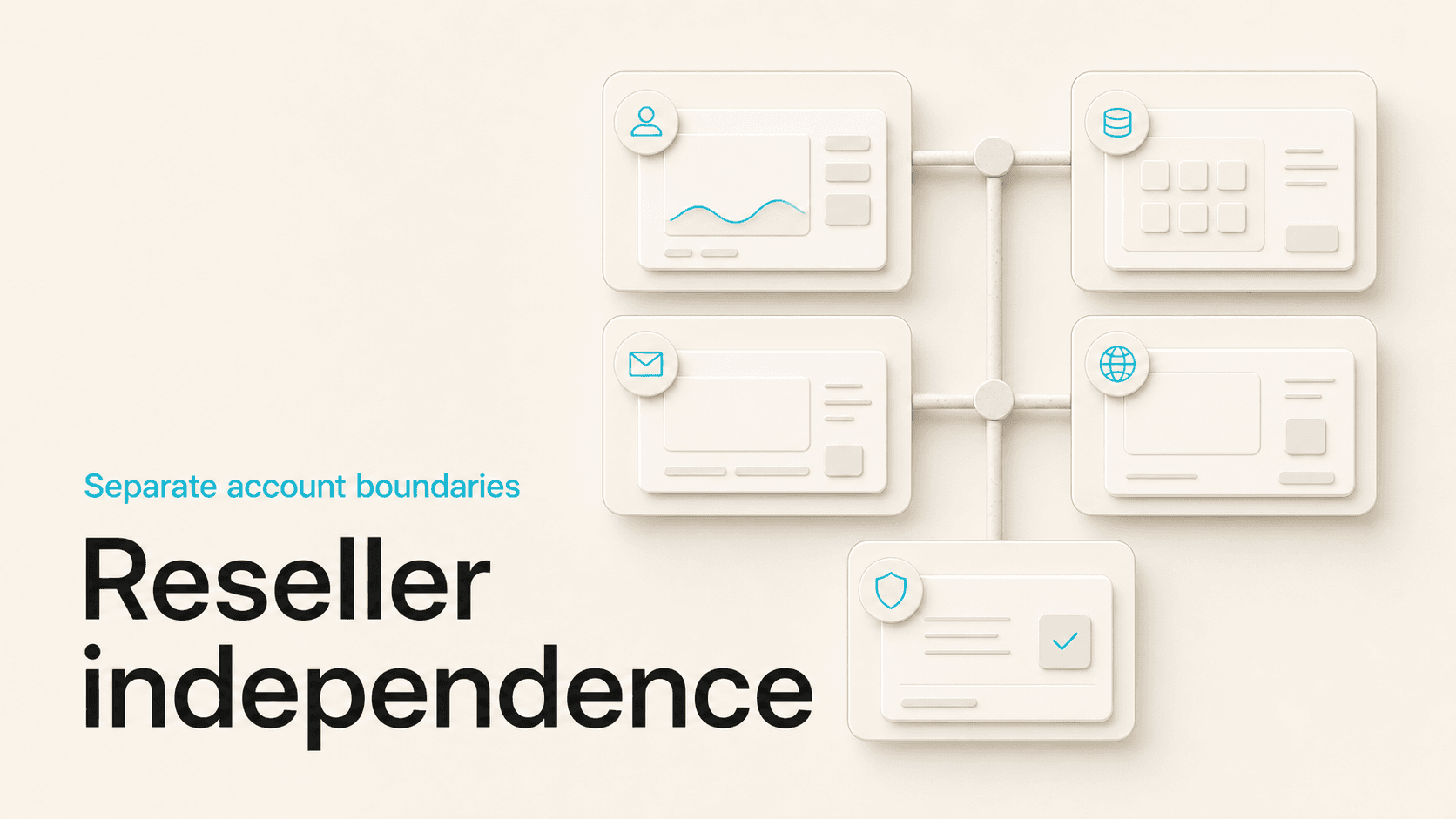
A modern reseller workspace should help providers create accounts, enforce packages, manage customer services and stay inside clear operational boundaries.
Reseller hosting is supposed to create independence. A provider should be able to onboard customers, apply sensible limits and handle routine account work without asking the server administrator to press every button.
If every mailbox, database or domain change still needs root access, the reseller cannot operate independently or support customers efficiently.
Synconix Hosting Manager gives resellers a dedicated workspace built around the customer estate they actually own. Accounts, domains, DNS coverage, assigned IP resources and package information stay visible without opening access to unrelated customers or server-wide controls.
Make ownership visible
The most important reseller rule is also the simplest: a reseller should manage only the accounts assigned to that reseller.
That boundary needs to hold everywhere, not only on the account list. File management, email, databases, DNS, backups, application controls and security tools should all resolve the account owner before an action is allowed.
This is useful for security, but it also makes the interface easier to understand. Resellers see the customers they are responsible for, while server administrators retain control over infrastructure-level decisions.
Packages are policy
Packages turn a hosting offer into a repeatable service. Before provisioning, a reseller package can define:
- disk and account limits;
- available features and shell access;
- eligible IP resources.
Synconix applies those rules during account creation and checks the reseller's remaining account and disk allowance. Compatible options stay available; options outside the reseller policy are not offered.
Clear resource limits help providers define consistent offers while keeping the underlying server predictable.
Keep customer work within reach
Once an account exists, the reseller still needs to support it. That means managing domains, websites, email accounts, databases, SSL, backups, files and application runtimes from the same account context.
A reseller should not have to jump between unrelated tools or request root intervention for normal customer work. Synconix keeps those operations together and carries the reseller ownership check into each account-level surface.
The result is faster support and fewer handoffs. Customers receive an answer from the team that manages their service, while the server administrator remains focused on infrastructure-level work.
Automation inherits the boundary
Automation is valuable only when it follows the same permissions as the interface. Every automated path must enforce the same account ownership boundary as the interface.
Reseller workflows in Synconix use the reseller role and account ownership when listing resources or performing actions. The AI workspace follows that same model, helping with reseller-owned accounts and documented reseller operations without turning a delegated role into root access.
This lets providers automate repetitive work while keeping responsibility clear. The system can move faster, but the security boundary does not move with it.
The business outcome
A reseller platform should reduce operational friction as the customer base grows. Clear ownership, reusable packages, scoped account controls and useful visibility make that possible.
For customers, this means quicker service and fewer confusing handoffs. For resellers, it means more control over daily work. For server administrators, it means delegated access that remains bounded and understandable.
A modern reseller workspace provides enough control to operate the service, clear guardrails to protect the server, and fewer routine requests that require root intervention.