Hosting management without the daily headache
Discover how Synconix Hosting Manager simplifies websites, email, databases, SSL, backups and applications through practical, security-focused automation.
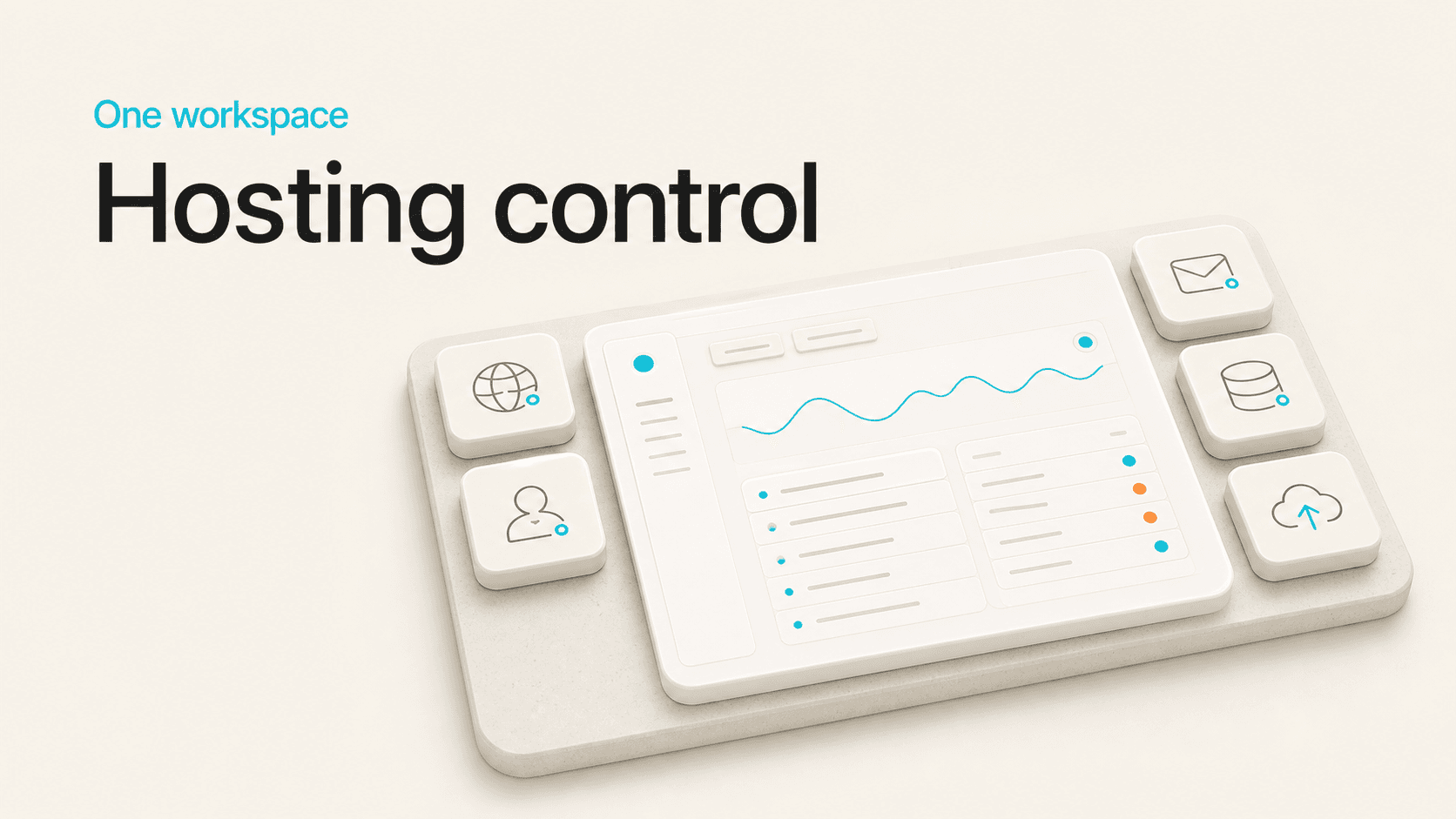
Synconix Hosting Manager brings websites, email, databases, SSL, backups and applications into one clear interface. Built for customers and hosting providers, it combines practical automation, strong security principles and day-to-day control without unnecessary complexity.
A hosting control panel has one simple job: help people manage their hosting without turning every small change into a support ticket.
That sounds obvious, but routine hosting work often spans several menus and configuration layers. A clear control panel should reduce that friction rather than add to it.
Synconix Hosting Manager was created to make hosting administration clearer, faster, and considerably less frustrating.
Synconix Hosting Manager brings everyday hosting operations into a clean, consistent interface. Customers can manage websites, domains, email accounts, databases, SSL certificates, backups, files, applications, and other services without needing to understand everything happening behind the scenes. Advanced users are not left behind. Node.js applications, Podman containers, service configuration, detailed logs, resource controls, and automation tools are available when the job requires more than clicking "Install WordPress."
The goal is simple: beginners should feel comfortable, while experienced administrators should still have the control they expect.
What daily hosting work actually includes
SHM is not just a collection of attractive dashboards. It is designed around the tasks hosting customers and administrators perform every day.
Creating an email account should take seconds. Application installation should follow a documented, repeatable path. Service actions should return a clear result and enough detail to address a failure.
Routine work is automated wherever possible, while important changes include validation, clear feedback, and recovery mechanisms. This helps reduce mistakes without taking control away from the administrator.
The integrated AI assistant can also help users understand their account and complete permitted operations. It follows the user's assigned role and account boundaries, and it can perform only the operations available to that user.
Security is ongoing work
Security is a continuing operational responsibility. SHM addresses it through layered controls rather than a single absolute claim.
The platform follows a practical security model: clear permission boundaries, account isolation, secure defaults, controlled privileged operations, two-factor authentication, encrypted connections, validation before critical changes, and detailed operational visibility.
The platform runs on infrastructure controlled by the hosting provider. This provides greater ownership over systems, services, and customer data, without depending on an opaque external control layer.
Security also means preventing operational mistakes. A configuration that looks correct but stops a database after restart is not secure or useful. That is why sensitive operations can include validation, health checks, backups, and automatic rollback when something does not work as expected.
Automation with a boundary
Automation should reduce repetitive work while keeping operational risk controlled.
SHM automates repetitive work while keeping important decisions visible. SSL management, account provisioning, application operations, service configuration, backups, and other administrative tasks are handled through predictable workflows.
This consistency matters as infrastructure grows. Administrators spend less time repeating manual steps, customers receive clearer results, and support teams can focus on actual problems instead of explaining where a button moved.
Backups are part of that philosophy. A backup policy is complete only when recovery has also been verified.
One platform, two working perspectives
For customers, Synconix Hosting Manager offers a modern and approachable way to manage hosting without needing permanent access to technical support. For hosting providers, it offers centralized administration, role-based access, automation, service management, account controls, and a platform that can evolve alongside their infrastructure.
The result is a better experience on both sides: customers can handle more tasks independently, while administrators retain the visibility and control required to operate reliable hosting services.
The best hosting work is uneventful
Good hosting is rarely dramatic. The website loads, email arrives, certificates renew, applications stay online, and backups are available when needed.
Routine service operations should be predictable and recoverable.
Synconix Hosting Manager is built to make reliable hosting easier to operate and easier to understand. It combines practical automation, strong security principles, modern application support, and a user-friendly interface in one platform.
An effective hosting control panel keeps routine work clear, returns useful results, and stays out of the way when no action is required.